




Employee engagement is a vital statistic for all companies on the employee relations front. Based on the latest findings from Gallup, however, it appears many employers are struggling in this area.
According to Gallup:
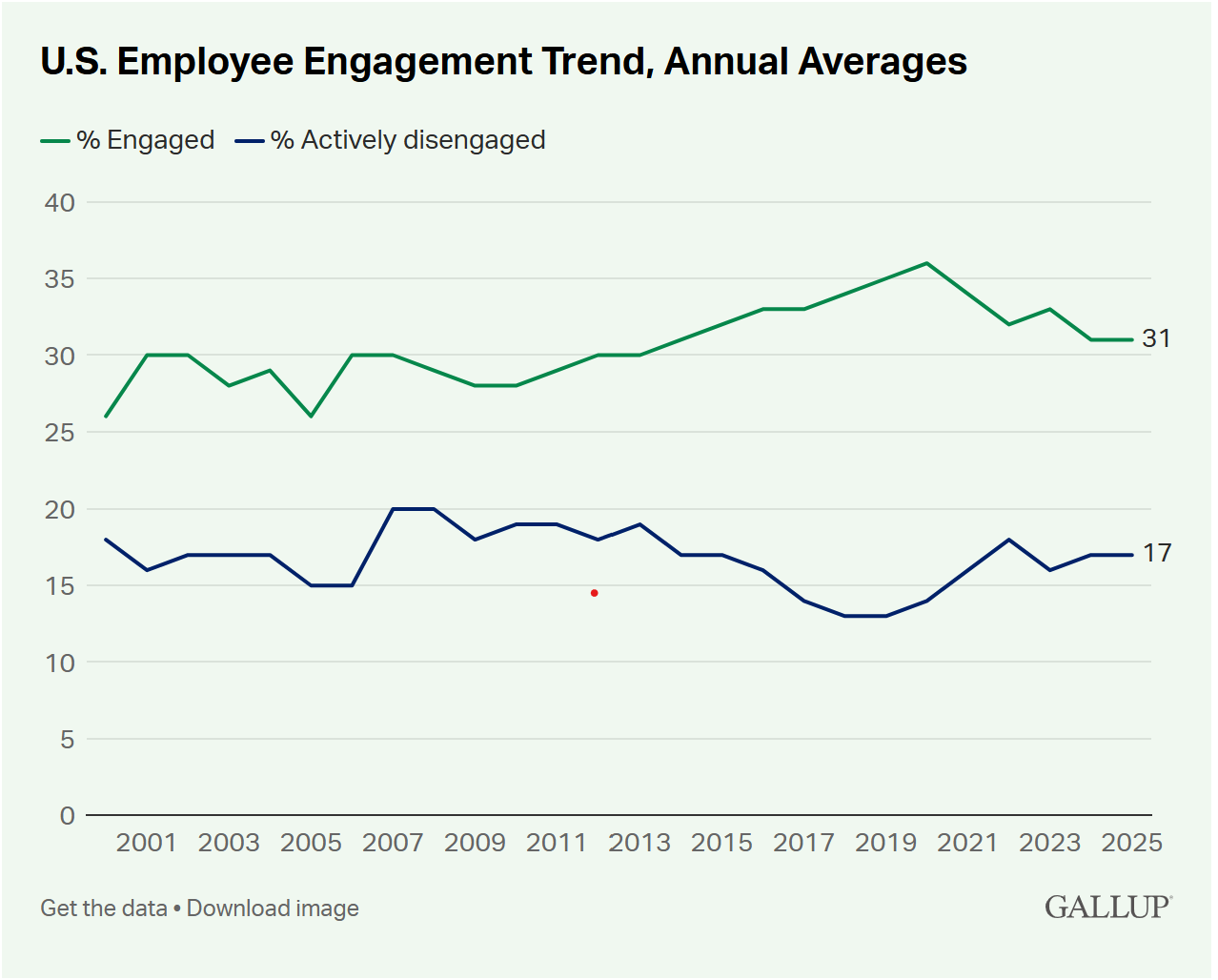
"The percentage of U.S. employees who are actively engaged at work averaged 31% in 2025, unchanged from 2024, according to Gallup’s employee engagement survey. This follows several years of decline from a high of 36% in 2020, which came after a decade of steady growth. Each percentage-point change in active engagement at work represents approximately 1.6 million full or part-time employees in the U.S. The declines since 2020 equate to about 8 million fewer engaged employees over five years, with 3.2 million fewer engaged workers compared to 2023 alone."
Gallup also published this helpful chart illustrating the decline:
Notably, while employee engagement has declined steadily since 2020, we've seen a historic rise in union organizing during this same time period. This is not too surprising. In my experience, the primary catalysts for employees seeking a union to represent their interests tend to revolve around engagement, specifically things like treatment by and respect from their managers, appreciation, a sense of belonging/importance to the organization, etc. While economic considerations like wages and benefits can come into play, they are rarely the original drivers of a unionization effort.
Gallup also noted in its findings:
"Between 2020 and 2025, younger U.S. workers experienced the largest drops in engagement. The percentage of Generation Z and younger millennials who are engaged at work dropped by eight points, while older millennials (born 1980 to 1988) dropped by nine points. Generation X declined in engagement by six points, and baby boomers saw no change in engagement since 2020."
This is also interesting data, as younger demographics likely account for much of the organizing push we've seen at companies like Starbucks, Trader Joe's, and others.
The bottom line? Employers should be concerned that employee engagement is on the decline. When that's the case, it creates an environment with a host of potential problems, including susceptibility to union organizing.
/Passle/6488d4630e7e25c9ac9f834a/SearchServiceImages/2026-10-01-16-36-37-700-6abe8c15d635d8950c18a33b.jpg)
/Passle/6488d4630e7e25c9ac9f834a/SearchServiceImages/2026-09-24-19-38-41-116-6ab57c414e2b53dc04f66ed6.jpg)
/Passle/6488d4630e7e25c9ac9f834a/SearchServiceImages/2026-09-24-00-30-45-657-6ab46f35f84433e70eea76ea.jpg)
/Passle/6488d4630e7e25c9ac9f834a/SearchServiceImages/2026-09-23-16-22-53-542-6ab3fcdd8657b143c1386d0a.jpg)